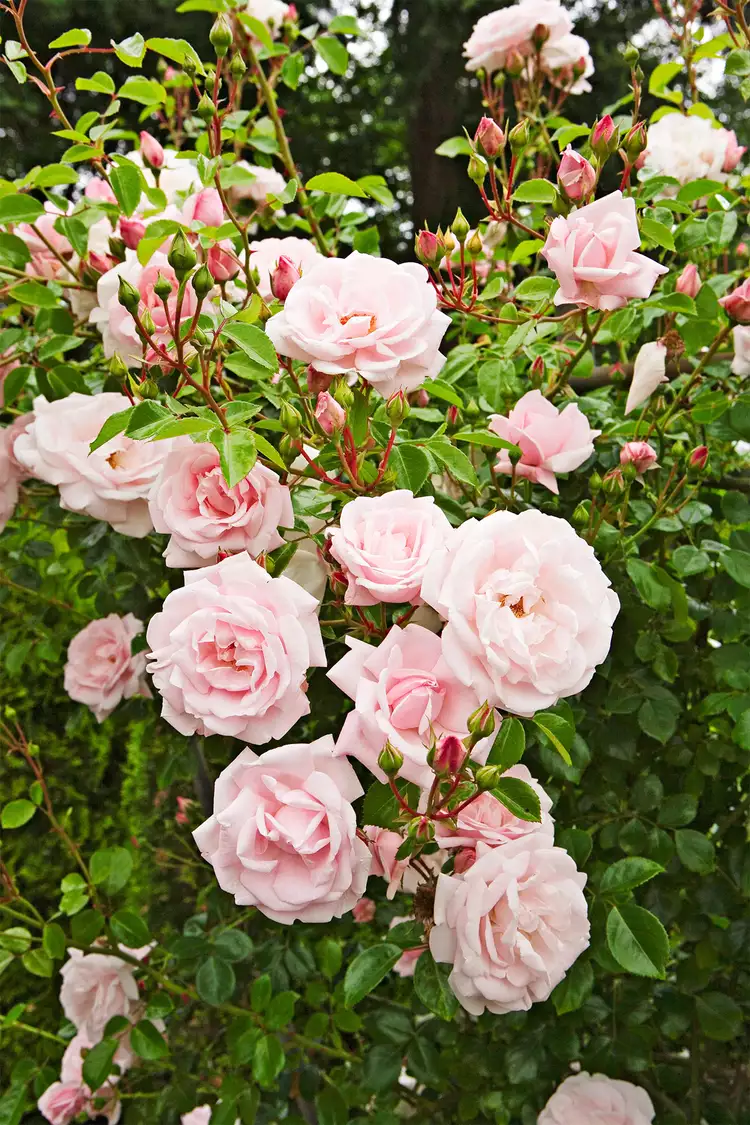
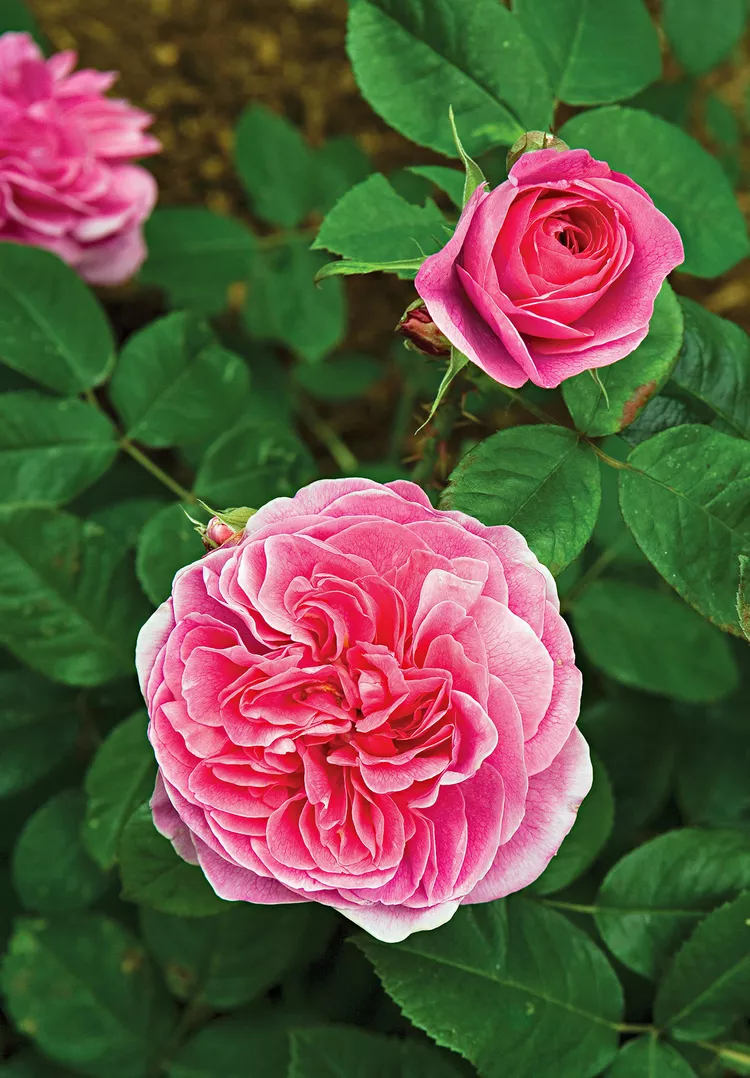
The rose may be an icon, but it often gets a bad reputation as a plant that demands a lot of care. In reality, many roses are landscape-worthy shrubs that don’t require constant devotion. Some of the best fall into the aptly-named shrub rose class. This group includes roses like Knock Out, which create color blocks of bloom almost all season and require almost no care. It’s also the place to look for some of the most cold-hardy roses for northern gardens, such as the Canadian Explorer Series. Even gardeners mostly interested in luxurious fragrances and blooms will find some of their best picks among the English shrub roses, which include several of the most fragrant roses ever bred.
The one thing most shrub roses have in common is that they have naturally attractive growth that doesn’t have to be shaped or fussed over very much to look good. They usually mix well with other types of shrubs, perennials, annuals, and small trees. You could even place one in a corner of your vegetable garden as an afterthought and get good results.
Shrub Rose Overview
| Genus Name | Rosa |
| Common Name | Shrub Rose |
| Plant Type | Rose, Shrub |
| Light | Sun |
| Height | 2 to 9 feet |
| Width | 2 to 15 feet |
| Flower Color | Orange, Pink, Purple, Red, White, Yellow |
| Foliage Color | Blue/Green |
| Season Features | Fall Bloom, Spring Bloom, Summer Bloom, Winter Interest |
| Special Features | Attracts Birds, Cut Flowers, Fragrance, Good for Containers, Low Maintenance |
| Zones | 10, 3, 4, 5, 6, 7, 8, 9 |
| Propagation | Grafting, Stem Cuttings |
Where to Plant Shrub Roses
Most shrub roses perform best in full sun. That means anywhere from at least 6 hours of direct sunlight to full dawn-to-dusk exposure. More sun usually means better growth, less disease, and more bloom. But there’s a tradeoff. All-day exposure can bleach the color of the blooms and sap the fragrance, especially in midsummer. It can also increase stress on the plant during heat waves and droughts.
If your desired planting site isn’t in full sun, you can still grow shrub roses. Many varieties do well in part sun (at least four hours) or dappled sun.
Roses that aren’t reliably cold hardy or heat tolerant where you live need a protected location or microzone. Plant tender roses near the side of a building or solid brick or stone wall. Keep heat-intolerant roses away from afternoon sun exposure. If a variety is far outside the climate where it’s hardy, your best option will be to grow the rose in a pot that you can move into an unheated garage during winter or into shadier spots during summer.
Most roses aren’t ideal for children’s play areas. There are only a few nearly thornless shrub rose options. Make sure children know to be careful around roses to avoid cuts or tears in their clothes.
How and When to Plant Shrub Roses
Shrub roses come potted or bare-root. For the widest selection, consider both options. Either works well, but they require slightly different treatment before and during planting.
Potted roses cost more and you may get less variety, but they’re convenient. They can be found at nurseries much of the year and you can plant them whenever the ground isn’t frozen, although the best times are in spring and early fall.
Before you remove the rose from its container, water it well. Dig a hole at least twice as wide and deep as the container. Amend the soil by adding composted manure and peat moss or an alternative like coconut coir. Without removing your rose from the pot, position it in the hole. Adjust the soil depth until your rose sits at the same depth as it does in the pot or slightly deeper. Remove it from the pot and put it back in place. Fill the hole back in and water the rose in thoroughly.
Bare-root roses are more cost-efficient and sometimes you get more options. They do require a little bit more planning: you have to order them during winter or early spring and because they come dormant, without soil, you have to plant them almost immediately after they arrive (or you can pot them for later if you’re not ready by April or early May).
Start by placing the bare-root roses in a bucket of water to rehydrate overnight or at least for a few hours. From there on, the planting directions are the same as for potted roses except that you create a little pyramid in the hole to sit the crown on and drape the roots over. Since you don’t have the potted soil level as a guide, you have to give a little bit more thought to how deep you plant a bare-root shrub rose. You can usually tell approximately how deep it had been planted in the growing field. Plant it at the same level or up to two inches deeper.
Shrub Rose Care Tips
Shrub roses are one of the easiest types of roses to grow. These tough roses have been bred to have the best attributes of all classes.
Light
Like all roses, shrub rose requires full sun, allowing the plant to bloom to its fullest extent on sturdy limbs.
Soil and Water
Make sure the soil drains well. Waterlogged soil may drown your rose. Prevent poor drainage by digging a deep hole during planting, especially if you have heavy clay or rocky soil.
The ideal pH for most roses is about 6.5. A simple and inexpensive soil test will help you check the pH of your planting bed so you can adjust it if necessary. But if you've already got other garden plants growing well in the site, roses probably will too.
Irrigation usually isn't necessary for most shrub roses after they’re established. Unless you have a drought or intense heat wave, a deep watering once every week or two should be enough. Always water at the base of the plant. Overheard watering encourages foliar disease.
Temperature and Humidity
Roses do best in temperatures between 60ºF and 70ºF, with humidity around 60 percent. Container roses are more susceptible to damage from cold than in-ground plants and may need winter protection.
Fertilizer
You may choose to fertilize your shrub roses to get them to bloom more, though many of them do fine without the help. If you’re only going to fertilize once a year, apply in early spring, ideally after the last frost. You can fertilize about once a month until August. Look for Rose-tone or slow-release fertilizers recommended for roses. A layer of organic mulch every year or two also will provide nutrients as it slowly breaks down.
Pruning
An annual pruning keeps a shrub rose blooming its best and gives you a chance to do a more thorough check for disease and damage. The most essential pruning rule with shrub roses is to remove any dead, damaged, or diseased growth. This is typically done in late winter or early spring, just before the buds break.
Removing some of the older growth can be beneficial if your shrub roses have been around for a while. This will open up the interior to improve air circulation and promote new growth from the base.
When pruning, look for cane borer damage. It’s very common. You’ll see a canal dug into a stem. Prune back until you reach wood that has not been tunneled into.
Unless your shrub rose is self-cleaning, it will bloom more if you deadhead it after each bloom cycle.
Potting and Repotting Shrub Roses
Growing a shrub rose in a container allows you to move it wherever you enjoy it the most. Long-term pots should be 16 to 24 inches deep or more with excellent drainage. They need to be filled with a rich potting mix that both drains well and holds moisture. You can buy mixes made for roses or adapt a general potting mix. Since potted roses depend more on you than in-ground roses, you’ll need to water once a week during the growing season and apply slow-release fertilizer several times a year.
If you notice a decline in your containerized shrub rose after a few years, it may mean that you need to repot it. You could either pot it up a size or replace some of the soil in the existing pot. If you plan to remove soil from the root ball, try to do that when the rose is dormant in later winter.
Pests and Problems
Shrub roses are tough, but they can still be affected by the same pests and diseases as other roses. They will probably recover from most of them without your help, but there are some diseases you really do need to watch out for. In North America, Rose Rosette Disease (RRD) tops them all. It’s lethal to roses, incurable, and spreads by tiny mites that can float on the wind or ride on animals. Symptoms vary and can be hard to diagnose, but if you see strange growth that doesn’t look like anything your rose has produced before, keep a close eye on it.
The most obvious symptom of RRD is witches brooms. The virus affects each rose differently, but witches brooms typically include a cluster of distorted stems like a small broom head. They’re often an unusually deep red that doesn’t turn green and have larger and more numerous thorns than normal. Both stems and thorns may have a fleshy, rubbery look and feel. Often the stems that make up a witches broom are noticeably thicker than the stem they emerge from. Foliage and flower buds will likely be heavily distorted. Immediately remove a rose with RRD and throw it in the trash (never add an infected plant to your compost to avoid spreading the disease).
How to Propagate Shrub Roses
The easiest way to propagate shrub roses is with softwood cuttings taken in late spring or early fall from new growth. Timing affects the success rate. Take your cuttings while flowers are open or immediately after they fade.
Use sharp, disinfected pruners to harvest 4- to 8-inch cuttings with several leaves. Make the cut at a 45-degree angle just below a leaf node. Remove the leaves from the bottom half of the cutting, as well as any flower buds or spent blooms. Leave two or three leaflets at the top of the cutting. Place the cuttings into moist potting mix in a small container with drainage holes.
Water the cuttings in. Cover the pot with a clear plastic bag to hold in humidity. Leave cuttings in an area with filtered or indirect light. Too much sun or heat will cook them.
Some roses may root within two weeks. Others may take months or not root at all. When you see good root growth appear in the pot, you can remove the clear cover. Pot the cuttings up into their own containers once you see vigorous new leaf growth.
It is illegal to propagate trademarked roses, so don't take cuttings from David Austin roses, Knock Out roses, or any other trademarked roses, even for your personal use. There are plenty of non-trademarked roses out there gardeners can propagate.
Types of Shrub Roses
Shrub roses are relatively easy to grow, but they’re a complex group. Instead of all belonging to one class of rose, there are shrub roses in seven different classes, which the American Rose Society divides into classic and modern types:
Classic: Hybrid Moyesii, Hybrid Musk, Hybrid Rugosa, Kordesii
Modern: English/English-style, Ground Cover, Landscape
Landscape and Ground Cover Shrub Roses
Landscape and ground cover are expansive groups that are exemplified by popular series like Kolorscape, Knock Out, and Oso Easy. They also include older heirloom varieties (but not Old Garden Roses). Most of the recent varieties are self cleaning, meaning you don’t even have to deadhead them to get them to bloom constantly. They grow well almost everywhere.
If you're looking to create perpetual blocks of color without constant care, these may be the roses for you. The drawback is that they tend to lack fragrance or dazzling flower forms. That's not a problem if they're meant to be seen from a distance as part of a tidy landscape or front yard. But it does mean that they might not be the best choice if you want something you can bury your nose in or use as a cut flower. Some of the heritage landscape shrub roses, however, are more fragrant and ornate so make sure to check the specs carefully.
Ground cover shrub roses are nearly as popular as landscape shrubs and there’s a lot of overlap between them. In theory, the defining difference is that ground cover is lower to the ground and should keep weeds from growing anywhere underneath. Some of these are short bushes, but others are actually short climbers or ramblers that creep across the ground. The flowers and foliage are often smaller than on landscape shrubs. They include groups like Drift and Flower Carpet.
English Shrub Roses
Also called English-style, these were created to have overall charm in the garden and vase. That often means exceptionally well-formed blooms, intense fragrances, refined colors, and elegant foliage and growth. The classic traits that made roses so popular in the first place. All but a couple of the oldest ones repeat bloom all season. Get a whiff of Jude the Obscure or Gertrude Jekyll and there’s a good chance you’ll become a rose-collecting gardener in short order.
Classic Shrub Roses
If you live in New England or Canada, some classic shrub roses will be as familiar as landscape roses. Look to this group for the most cold-hardy options and the most natural, graceful shrub forms. Some of the kordesii roses, like the Canadian Explorer Series, and the hybrid rugosas can grow in Zones 3 or even 2. Another valuable perk of the hybrid rugosas is that some of them can grow in sand and tolerate winter road salt, hence they are widely planted in road medians in the north.
The only caveat to the classic shrubs is that a few may get too large for home landscapes and some (but not most) only bloom once a year. So if you’re looking for something that will repeat flower, or you want a shrub that can be kept a manageable size, make sure you check the mature size before buying.
Ballerina Rose
A classic hybrid musk rose with contemporary looks, 'Ballerina' is a shrub rose that bears a delicate pastel combination of deep rosy pink and white petals in the single flowers from late spring through fall. Small rose hips follow, brightening the bare tips through the winter and attracting birds. It grows 3 to 6 feet tall and almost as wide. Zones 4-10
Blanc Double de Coubert Rose
Rosa 'Blanc Double de Coubert' is a vigorous antique from late 19th-century France. It produces extremely fragrant, semidouble blooms in clusters. A good repeat bloomer, it grows up to 7 feet tall. Zones 3-9
Bonica Rose
Rosa 'Meidomonac' was one of the first shrub roses, and this award winner is still one of the best. It delivers a disease-resistant performance, soft pink flowers spring to fall, and orange hips that bring winter interest to the garden. It grows 5 feet tall and 4 feet wide. Zones 4-9
Carefree Beauty Rose
Rosa 'Bucbi' set a standard for disease resistance coupled with continuous bloom. Its double, soft pink blooms repeat reliably from early summer to fall on upright plants. At maturity, it reaches 5 feet tall and 3 feet wide. Zones 4-9.
Carefree Spirit Rose
Rosa 'Meizmea' is an award-winning variety with cherry-red flowers in a continuous show from late spring through fall. The plant is vigorous and covered with dark green foliage. Grows 5 feet tall and wide. Zones 5-9
Carefree Wonder Rose
Rosa 'Meipitac' bears fully double, baby pink blooms abundantly all summer on a disease-resistant plant. It grows 4 feet tall and 3 feet wide. Zones 4-9
Home Run Rose
Rosa 'Wekcisbako' shows single, bright red blooms that open to reveal gold stamens. The deepest color occurs in cold temperatures. A quick repeat bloomer, the plant requires light shaping to train its strong shoots. It's resistant both to black spot and powdery mildew. The rounded plant grows 4 feet tall and wide. Zones 4-9
Daydream Rose
Rosa 'Dicjeep' is an award-winning variety with vivid, deep-pink blooms that cover the low-growing plant (2 feet tall and wide). The leaves are glossy and show excellent disease resistance. Zones 4-9
Hansa Rose
Rosa rugosa 'Hansa' bears red-violet, cupped blooms packed with many clove-scented petals. Early, abundant flowering is followed by repeat bloom later in the season. The plant exhibits many traits of its rugosa heritage: disease resistance, thorniness, and extreme cold hardiness. It grows 5 feet tall. Zones 4-9
John Cabot Rose
Rosa 'John Cabot' is a tall, vigorous variety that yields clusters of deep fuchsia-pink, fragrant blooms. The plant grows 6 feet tall. Zones 3-8
Knock Out Rose
Rosa 'Radrazz' is an award-winning variety with cherry-pink blooms that have white centers and cover the plant. Small orange hips carry the show into late fall and appeal to the birds. The plants are extremely disease resistant and grow about 3 feet tall. Zones 5-9
Little Mischief Rose
Rosa 'Baiief' is a compact shrub that features deep pink, white-eyed blooms that fade to a lighter pink as they mature. The clustered flowers are cupped and semidouble. The disease-resistant plant grows 3 feet tall and wide. Zones 4-9
Snowdrift Rose
Rosa 'Bairift' features full, multipetaled white blooms opening from plump light apricot buds. The flowers appear in bunches on an upright, vigorous plant. Zones 4-9
Sunrise Sunset Rose
Rosa 'Baiset' is an outstanding, heavy-blooming selection that offers bright pink flowers that blend to warm peachy-pink at the center. It grows 4 feet tall and wide. Zones 4-9
Super Hero Rose
Rosa 'Baisuhe' is a disease-resistant, everblooming selection with rich red flowers. It grows 5 feet tall and 4 feet wide. Zones 4-9
William Baffin Rose
Rosa 'William Baffin' is free-flowering and laden with double, deep pink bloom clusters on glossy, disease-resistant foliage. The blooms are lightly fragrant. Plants grow from 7 to 9 feet tall. Zones 3-8
Garden Plans for Shrub Roses
Clay Soil Garden Plan
Even if you're stuck with heavy, clay soil, you can still grow a lovely garden. Follow this garden plan for a stunning design that can hold up to dense soil.
Easy-Care Summer-Blooming Shade Garden Plan
This mix of flowering shrubs and perennials will fill your yard with color all summer long—plus provide interest in spring, fall, and winter.